
CNC Bending Machine Manufacturers in India - Mech X
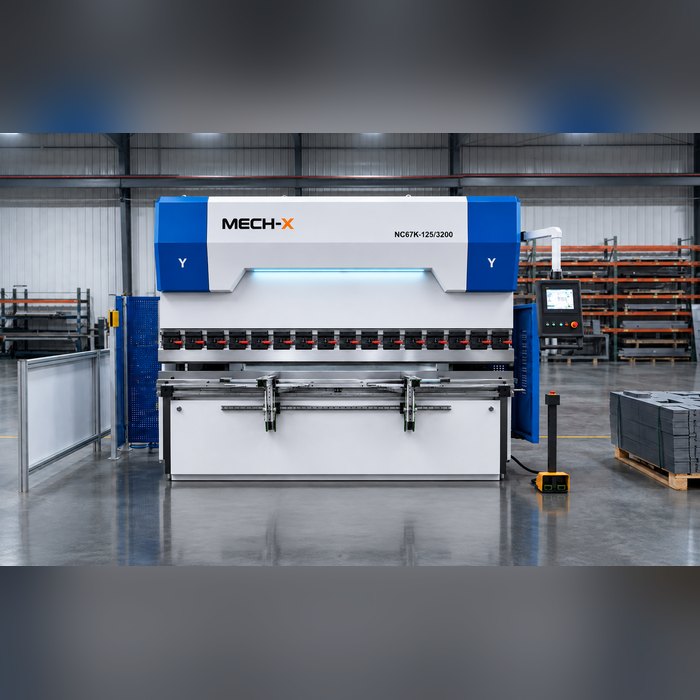


MECH X is leading CNC Bending Machine Manufacturers, Suppliers, Dealers and Exporters in India. A CNC Bending Machine is designed to form metal sheets, plates, tubes, and other workpieces into accurate angles and profiles through controlled bending operations. CNC technology helps automate positioning, bending sequences, and repeat production.
Modern bending equipment is available in hydraulic, electric, servo, hybrid, and mechanical configurations. Depending on the application, manufacturers can select a press brake, panel bender, tube bender, or specialized sheet metal bending system.
These machines are widely used in fabrication, engineering, automotive, electrical, furniture, and industrial manufacturing. Their programmable operation helps improve dimensional consistency while reducing repetitive manual adjustments during production.
What is a CNC Bending Machine?
A CNC Bending Machine is a computer-controlled metal forming system that applies controlled force to bend a workpiece according to a programmed angle and position. Unlike manual bending equipment, the CNC controller coordinates machine movement and bending parameters for repeatable production.
A CNC Metal Bending Machine can be configured for sheet, plate, tube, and pipe applications. Press brake systems use a punch and die arrangement to form sheet metal, while specialized tube and panel bending machines use application-specific tooling and mechanisms.
The machine can be selected according to material thickness, component dimensions, required bend angle, production volume, and automation requirements. Computer numerical control allows operators to store and execute programmed bending sequences with greater consistency.
Working Principle of CNC Bending Machine
The bending process generally follows these stages:
- Component Drawing: The required component dimensions, bend angles, flange lengths, and material information are established from the production drawing.
- Program Preparation: Bending parameters and the required sequence are entered into the CNC control system.
- Tool Selection: Suitable punches, dies, clamps, or specialized tooling are selected according to the material and desired bend geometry.
- Workpiece Positioning: The sheet, plate, tube, or pipe is accurately positioned against the machine reference points or back gauge.
- Parameter Setting: Important values such as bending angle, force, material thickness, and tool position are configured.
- Clamping and Alignment: The workpiece is held securely and aligned to prevent unwanted movement during forming.
- Controlled Bending: The machine applies programmed force through the selected tooling to form the material to the required angle.
- Position Adjustment: For components requiring multiple bends, the CNC system coordinates subsequent positions and bending sequences.
- Dimensional Inspection: The finished part is checked for bend angle, flange dimensions, overall geometry, and repeatability.
- Production Continuation: Once the program is validated, the same sequence can be repeated for subsequent components with minimal manual intervention.
Types of CNC Bending Machine
As we are leading CNC Bending Machine Manufacturers in India, our Types are designed to meet different application requirements and industry standards, including the following types:
- CNC Press Brake Bending Machine: Uses a punch and die system to bend metal sheets at specified angles. It is widely used in sheet metal fabrication, automotive manufacturing, electrical enclosures, and industrial equipment production.
- CNC Hydraulic Bending Machine: Uses hydraulic power to apply controlled force during the bending process. It is suitable for bending thick metal sheets and components that require high bending force and consistent results.
- CNC Electric Bending Machine: Uses electric servo motors to control bending movements with high precision and energy efficiency. It is commonly used for applications requiring repeatability, accurate positioning, and reduced energy consumption.
- CNC Hybrid Bending Machine: Combines hydraulic and electric servo technologies to provide controlled bending performance and efficient power usage. It is suitable for industrial applications involving different material thicknesses and production requirements.
- CNC Sheet Metal Bending Machine: Designed specifically for bending flat metal sheets into channels, brackets, panels, and other fabricated components. It is widely used in manufacturing, construction, and metal fabrication industries.
- CNC Plate Bending Machine: Designed to bend thick and heavy metal plates into curved or cylindrical shapes. It is commonly used in pressure vessel manufacturing, shipbuilding, storage tank production, and heavy engineering.
- CNC Tube Bending Machine: Uses programmed bending movements to form metal tubes into specified angles and radii without unnecessary deformation. It is suitable for automotive exhaust systems, furniture frames, hydraulic lines, and industrial piping.
- CNC Pipe Bending Machine: Designed to bend metal pipes into precise angles and configurations for fluid transportation and structural applications. It is widely used in oil and gas, power generation, construction, and process industries.
- CNC Profile Bending Machine: Bends metal profiles such as angles, channels, beams, and flat bars into curved or circular shapes. It is suitable for structural fabrication, architectural frameworks, and industrial component manufacturing.
- CNC Wire Bending Machine: Uses automated feeding and bending mechanisms to produce wire components in programmed shapes. It is commonly used for manufacturing springs, wire forms, brackets, clips, and metal fixtures.
Other specialized configurations include CNC Sheet Bending Machine, CNC Tube Bending Machine, CNC Pipe Bending Machine, and advanced press brake machine equipment for application-specific forming requirements.
Technical Specifications of CNC Bending Machine
As a trusted CNC Bending Machine Suppliers in India, we serve businesses across various industries that meet professional visual communication requirements.
| Parameter | Typical Specification | Bending Technology | Application | Configuration |
|---|---|---|---|---|
| Machine Type | CNC Bending Machine | Press Brake / Panel / Tube | Metal Forming | CNC Controlled |
| Bending Capacity | Model Specific | Hydraulic / Electric / Servo | Sheet & Plate | Application Based |
| Control System | CNC Controller | Programmed Movement | Automated Bending | Digital |
| Drive Technology | Hydraulic / Servo / Electric | Controlled Force | Precision Forming | Configurable |
| Material | Mild Steel / Stainless Steel / Aluminium | CNC Bending | Sheet & Plate Work | Process Dependent |
| Tooling | Punch & Die / Specialized Tooling | Controlled Forming | Component Production | Customized |
| Bending Angle | Application Dependent | CNC Controlled | Profile Formation | Programmable |
| Machine Structure | Industrial Frame | Guided Movement | Fabrication | Heavy Duty / Standard |
| Back Gauge | CNC Controlled | Positioning System | Accurate Bending | Multi-Axis Options |
| Automation | Manual Assisted to Automatic | CNC Sequence | Production Bending | Configurable |
Features and Benefits of CNC Bending Machine
As CNC Bending Machine Dealers in India, our products provide several Features and Benefits including consistent quality, smooth finish, and long service life.
| Feature | Benefit |
|---|---|
| CNC-controlled operation | Provides programmed positioning and repeatable bending sequences. |
| Programmable bending angles | Helps achieve consistent component geometry across production batches. |
| Automatic back gauge | Improves workpiece positioning and reduces repeated manual measurement. |
| Multiple drive options | Hydraulic, electric, servo, and hybrid technologies can be selected according to application needs. |
| Precision tooling | Suitable punch and die combinations support controlled material forming. |
| Multi-bend programming | Allows several bending operations to be organized within one production sequence. |
| Automated operation | Reduces repetitive manual adjustments during regular production. |
| Strong machine construction | Supports stable bending performance under industrial operating conditions. |
| Application flexibility | Equipment can be configured for sheets, plates, tubes, or pipes. |
| Repeatable production | Stored CNC programs help maintain consistency between successive components. |
Applications of CNC Bending Machine
As CNC Bending Machine Exporters in India, our all types are used in various types of industrial sectors such as:
- Sheet metal fabrication: A CNC sheet metal bending machine can form panels, brackets, covers, cabinets, and fabricated assemblies.
- Metal sheet forming: CNC metal sheet bending machines are used to create programmed angles and profiles from sheet materials.
- Plate bending: A CNC plate bending machine can process suitable plate materials for structural and industrial components.
- Press brake operations: CNC press brake machines are widely used for forming sheet and plate components with programmed bend sequences.
- Electrical enclosures: Bending systems can produce accurately formed panels, cabinets, covers, and enclosure components.
- Automotive components: CNC bending equipment supports fabrication of brackets, structural parts, panels, and other formed components.
- Tube and pipe fabrication: CNC Tube Bending Machine and CNC Pipe Bending Machine configurations are used for producing controlled bends in tubular components.
- Commercial fabrication: Heavy Duty Commercial Automatic CNC Bending Machine systems can support repetitive industrial and commercial production.
- Precision engineering: Precision CNC press brake systems are used where controlled angles and repeatable component dimensions are important.
- Automated manufacturing: Automatic CNC bending machine configurations can support production lines requiring programmed and repeatable forming.
- Hydraulic bending: Hydraulic CNC bending machines and servo hydraulic bending machines are suitable for applications requiring controlled forming force.
- Electric bending: Electric CNC bending machine and all electric CNC bending machine configurations provide an alternative to conventional hydraulic systems.
- Hybrid forming: Hybrid CNC bending machine and hybrid CNC press brake systems combine different drive technologies for application-specific requirements.
- Servo-controlled production: Servo electric bending machine systems provide controlled movement for applications requiring repeatable positioning.
- Specialized forming: CNC Panel Bending Machine and CNC bending machinery can be integrated into specialized sheet metal manufacturing operations.
Why Choose Us?
As one of the leading CNC Bending Machine Manufacturers in India, we deliver premium-quality solutions designed to meet diverse industrial requirements. Here's why we stand out:
- 500+ Machines Installed: Our installation experience covers diverse metal forming and fabrication requirements.
- 300+ Happy Clients: We have supplied solutions to customers across different industrial applications.
- 25+ Skilled Engineers: Our technical team supports machine selection, installation, commissioning, and application requirements.
- 15+ States Served: Our machines and technical support have reached customers across multiple regions in India.
- 15+ Years Industry Experience: Our industry knowledge helps us understand practical requirements for sheet metal forming and industrial bending.
Choose MECH X is leading CNC Bending Machine Manufacturers, Suppliers, Dealers and Exporters in India. A CNC Bending Machine provides controlled and repeatable metal forming for modern fabrication and manufacturing operations. With programmable positioning, automated sequences, and application-specific tooling, these machines can produce consistent bends across different component designs. Hydraulic, servo, electric, hybrid, and mechanical configurations provide manufacturers with multiple technology options. Press brake systems are widely used for sheet and plate forming, while specialized equipment can handle tubes, pipes, and panels. Selecting the right machine requires consideration of material type, thickness, component dimensions, bending force, required accuracy, production volume, tooling, and desired automation level. The appropriate configuration can improve productivity while maintaining consistent component quality.
FAQs
A CNC Bending Machine is a computer-controlled metal forming system that bends sheets, plates, tubes, or other compatible workpieces according to programmed dimensions and angles.
A CNC press brake machine uses a punch and die system to form sheet or plate material. CNC control manages positioning, bending angles, and production sequences.
Depending on the machine and tooling, CNC bending equipment can process materials such as mild steel, stainless steel, aluminium, and other suitable metal grades.
A CNC hydraulic press brake uses hydraulic power to generate the force required for bending. CNC controls coordinate machine movement and positioning for repeatable forming.
An electric CNC press brake uses electrically driven mechanisms, commonly servo-based systems, to control bending movement and positioning without relying primarily on conventional hydraulic power.
Hydraulic systems generate bending force through hydraulic components, while servo electric systems use electrically driven mechanisms for controlled movement. The appropriate option depends on force requirements, production volume, energy considerations, and application needs.
Yes. Dedicated CNC Tube Bending Machine and CNC Pipe Bending Machine configurations are designed to produce controlled bends in tubular components.
A Press Brake 100 Ton CNC Bending Machine is designed for applications requiring a higher level of bending force, with actual capacity depending on material type, thickness, tooling, and component dimensions.
A hybrid CNC bending machine combines different drive technologies to achieve a balance of controlled movement, bending performance, and application-specific operating characteristics.
Selection should consider material type, thickness, maximum component length, required bending force, bend angle, tooling, production volume, automation requirements, and whether the application involves sheets, plates, tubes, or pipes.


